
How to create a gallery wall in a nursery

James Eltherington
Founder & Designer
22 March 2026 · Updated 28 April 2026
James founded TypePosters in 2015 and leads the studio's design. He started it on a simple belief — that your walls deserve something more considered than a mass-produced print — and still has a hand in every design that leaves the studio.

A gallery wall is one of the most effective ways to add personality to a nursery without committing to a single large piece of art. Done well, it creates a focal point that grows with the room — you can add, swap, and rearrange pieces as your child gets older without starting from scratch.
This guide walks through the entire process, from choosing your prints to putting the final nail in the wall.
Start with the wall, not the art
The most common mistake people make with gallery walls is buying prints first and figuring out the layout later. Start the other way around.
Stand in the nursery and look at the wall you are considering. Measure the available space — not just the total wall area, but the usable space between furniture, light switches, shelves, and the cot. A gallery wall needs breathing room. As a rule, keep the arrangement at least 15-20cm from any furniture edge and at least 10cm from the ceiling.
Take a photo of the wall with your phone. You will use this later when planning the layout.
Choosing a theme
A gallery wall works best when there is a thread connecting the pieces, even if the connection is loose. In a nursery, that thread is usually one of:
- A colour palette — three or four colours that run through every print. This is the easiest way to create cohesion. Pull colours from the room's existing scheme (bedding, curtains, rug) and choose prints that stay within that palette.
- A style family — all prints in the same aesthetic. Typography posters work particularly well here because they share a visual language even when the individual designs are different.
- A subject — all animals, all botanicals, all letters. Name displays are a natural fit for nurseries, spelling out the child's name or initials across multiple frames.
- A personal story — prints that mean something specific to the family. The child's initial, the parents' initials, a birth year.
You do not need to pick just one approach. A name display using typographic prints of different styles is both a subject (letters) and a personal story (the name). The key is that a visitor should be able to look at the wall and sense that the pieces belong together.
How many prints?
Gallery walls can work with as few as three prints or as many as fifteen. For a nursery, we find that five to nine prints is the sweet spot. Fewer than five can look sparse above a cot, and more than nine starts to feel busy in a room that should feel calm.
Odd numbers tend to look more natural than even numbers. A set of three, five, or seven prints avoids the rigid symmetry that can make a gallery wall feel like a corporate lobby.
Choosing print sizes
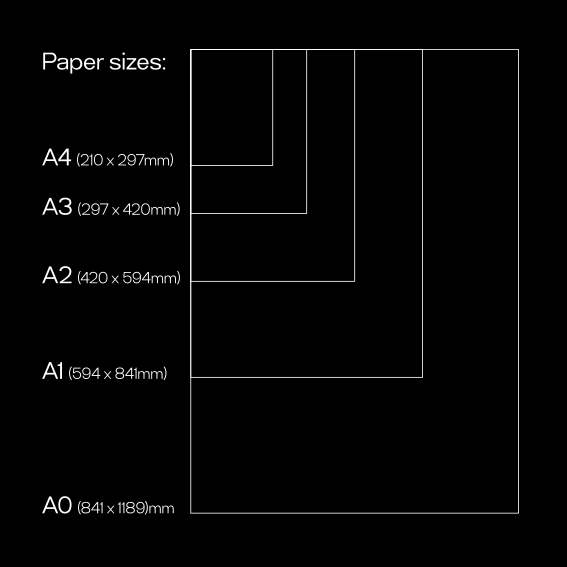
Size is where most people get nervous, but there are some reliable guidelines:
- A4 (21 × 29.7cm) — The smallest size we offer. Works well in groups and as supporting pieces around a larger centrepiece. Two or three A4 prints stacked vertically create a column that adds height to a layout.
- A3 (29.7 × 42cm) — The most versatile size for gallery walls. Large enough to hold its own, small enough to fit several on a single wall. If you are spelling out a name, A3 is usually the right choice for four or more letters.
- A2 (42 × 59.4cm) — A strong middle ground. Use one or two A2 prints as anchor pieces in a larger arrangement, surrounded by smaller A4 and A3 prints.
- A1 (59.4 × 84.1cm) — A statement size. One A1 print can be the centrepiece of a gallery wall, with smaller prints arranged around it. Above a cot, a single A1 print often has more impact than a cluster of smaller pieces.
- A0 (84.1 × 118.9cm) — A true focal point. At this size, you probably do not need a gallery wall at all — one A0 print fills a wall beautifully on its own.
Mixing sizes for visual interest
The most compelling gallery walls mix two or three different sizes. A grid of identical prints can look elegant, but mixing sizes creates movement and draws the eye across the arrangement.
A reliable formula: choose one size for your anchor piece (A2 or A1), one size for supporting pieces (A3), and one size for accent pieces (A4). Place the anchor piece slightly off-centre, cluster the supporting pieces around it, and tuck the accent pieces into the gaps.
Planning your layout
Before you pick up a hammer, plan the layout on the floor or use a digital tool.
The floor method
Lay your prints (or paper cut to the same sizes) on the floor in the arrangement you are considering. Step back and look at it from above. Move pieces around until the spacing and balance feel right. Take a photo for reference before you move to the wall.
The paper template method
Cut pieces of brown paper or newspaper to the exact sizes of your prints. Tape them to the wall with painter's tape. This lets you see the real proportions and spacing on the actual wall before making any holes. Adjust, step back, adjust again. Only when you are happy do you replace the paper with prints.
The digital method
Our Wall Designer tool lets you drag and drop different poster designs onto a virtual wall, choosing sizes and characters as you go. It is the fastest way to experiment with layouts without any cutting, taping, or measuring.
Spacing & alignment
Consistent spacing is what separates a gallery wall from a collection of randomly placed prints. Here are the numbers that work:
- 5-7cm between frames — This is the standard gallery spacing. It is close enough that the prints read as a group, but far enough apart that each piece has its own space.
- Align the centre line — In a horizontal arrangement, align the vertical centre of each print. This creates a visual horizon line that holds the arrangement together even when the sizes vary.
- Match the gaps — Keep all horizontal gaps the same width and all vertical gaps the same height. Inconsistent spacing is the fastest way to make a gallery wall look amateur.
Hanging height
The standard gallery rule is to hang art so the centre of the arrangement is at eye level — roughly 145cm from the floor. In a nursery, you might want to adjust this downward slightly if the wall is above a low piece of furniture like a changing table.
Above a cot, hang prints at least 30cm above the top rail. This keeps them safely out of reach and creates a comfortable visual gap between the furniture and the art.
Framing options
Frames unify a gallery wall and protect the prints. You have three main approaches:
- Matching frames — All frames in the same colour and style. This creates maximum cohesion and works especially well with typographic prints where you want the designs to be the focus, not the framing.
- Mixed frames — Different frame styles and colours. This works when you want a more eclectic, collected-over-time look. Keep at least one element consistent (all wood, or all thin profiles, or all the same colour) to prevent it looking chaotic.
- No frames — Unframed prints pinned or taped to the wall have a relaxed, studio feel. This works in playrooms and creative spaces but is less practical in nurseries where the prints need protection.
For nurseries, we generally recommend matching frames in white, natural wood, or black. Simple, thin-profile frames let the typography take centre stage.
Step-by-step hanging guide
Once your layout is planned and your prints are framed, here is how to get them on the wall:
- Mark the centre point of your arrangement on the wall with a small pencil mark.
- Start with the anchor piece (your largest or most central print). Hold it against the wall and mark where the hanging hardware meets the wall.
- Drive your first hook or nail. Hang the anchor piece and check it is level.
- Work outward from the anchor. Use a ruler or spacer cut to your chosen gap width (5-7cm) to maintain consistent spacing.
- After every two or three prints, step back to the doorway and check the overall balance.
- Make micro-adjustments. Most frames can be nudged a millimetre or two on their hooks without redrilling.
Gallery wall ideas for nurseries
The name display
Spell out your child's name using one poster per letter, all in the same design style. A four-letter name in A3 prints creates a display roughly 120cm wide — perfect above a cot or changing table. For longer names, drop to A4 or stagger the letters in two rows.
The initial statement
A single large initial (A1 or A0) flanked by two or three smaller complementary prints. The initial is the centrepiece, and the surrounding prints add context — perhaps a matching style in different colours, or a mix of sizes that creates an asymmetric arrangement.
The sibling set
For shared rooms or when a new baby arrives, create a display with both children's initials. Two A2 prints side by side, or two clusters of smaller prints, one for each child. Use the same design style in different colour variants to show that the children are connected but individual.
The colour story
Choose five to seven prints in different styles but the same two or three colours. Arrange them in a loose cluster. This approach works when you want variety in the designs but cohesion in the overall look. It is especially effective in nurseries with a strong colour scheme.
Common mistakes to avoid
- Hanging too high. The most common error. If your prints feel disconnected from the furniture below, they are probably too high.
- Inconsistent spacing. Even a 1cm difference between gaps is noticeable. Use a physical spacer.
- Too many styles at once. Three different typography styles can look curated. Six looks confused.
- Ignoring the room's other elements. The gallery wall should complement the room, not compete with patterned wallpaper or busy bedding.
- Rushing the layout. Spend twice as long planning as you think you need. The hanging itself takes minutes.
Maintaining your gallery wall
Dust framed prints every few weeks with a soft, dry cloth. Avoid hanging giclée prints in direct sunlight — while our pigment-based inks are fade-resistant, prolonged UV exposure will eventually affect any print. If the nursery gets strong afternoon sun, consider UV-protective glass in your frames.
The beauty of a gallery wall is that it evolves. As your child grows, you can swap out prints, add new pieces for birthdays or milestones, and gradually hand over the curation to the child themselves. A gallery wall is not a finished project — it is a living part of the room.